An operations agent · neatHacks 2026
Start with a problem.
Rook proves the fix.
Every organisation runs on work that falls between its systems, and a person ends up doing it by hand. Rook does that work: it investigates across everything connected, waits for a human before anything reaches someone outside, then checks the result and shows the proof.
No sign-up for the demo. Every system behind it is a sandboxed copy with made-up data, so nothing real is touched and no real person is contacted.
A Monday morning, start to finish
A doctor calls in sick. Twelve patients are booked in with her today, the first at nine. None of them know. Somebody at the front desk is about to lose the morning to the phone.
It reads the appointment book, the patient records and the messaging system. Eleven can be moved to a colleague at a similar time, and each person is told by text. The twelfth cannot: the only number on file for her is dead.
Eleven moved and confirmed, checked against the systems themselves. The twelfth is not quietly moved — her appointment stays where it is, and reception gets her name, her time and the reason.
22 steps23 of 24 checks passed1 refused, with the reasonnothing marked done that was not
The same engine does the same thing for a pitch shut on a Saturday, an API key that outlived the person who made it, or a service failing after a deploy. Open the demo and run this one yourself.
How it works
- 01Someone reports itA doctor is off. A pitch is shut. Someone left and their keys did not. Staff raise it in one place, or a connected system does.
- 02Rook investigatesIt reads every system the problem touches and works out who and what is really affected. Nothing is changed while it looks.
- 03A person approvesIt proposes the fix as ordered steps. Anything that reaches someone outside your organisation waits for a human yes.
- 04Rook proves itIt checks the result on the systems themselves and shows the evidence. Whatever it could not finish stays open, named, with the reason.
The same engine, wherever the work falls
A doctor off sick with a day of patients booked in. Referrals and results the record calls done that never happened.
Someone left, but their accounts and API keys live on. A scanner finds a live key in a repository.
A production service starts failing right after a change, and auto-deploy keeps putting it back.
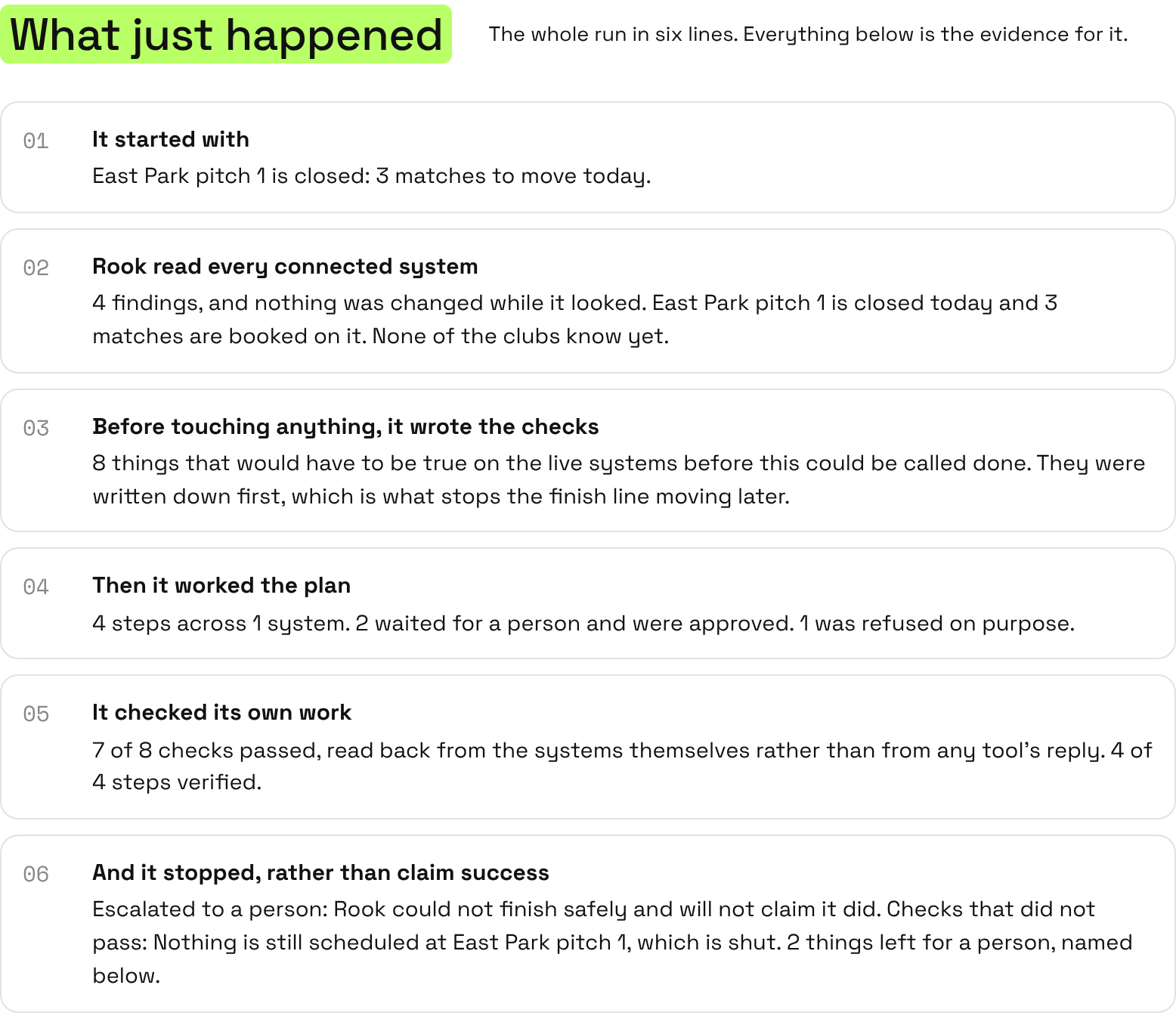
A pitch is shut on a Saturday. Three matches, six clubs and three referees, all needing to be told.
What makes it different
Before changing anything, Rook writes down what would have to be true on the live systems before this can be called done. The finish line cannot move later.
Every step is read back from the system it ran on: the appointment book, the pharmacy’s queue, an authentication probe, a synthetic order.
Of 40 scenarios, 24 end without closing: no slot free, nobody who can be told, a key whose revocation would break a live service. Each one is named, with the reason.
And it shows its working
Every run ends with a plain account of what happened, and the evidence for each line of it underneath: the plan, every check with what was observed on the live system, what it refused to do, and a tamper-evident log. This is a real one.
GET NOTIFIED
Join the waitlist
One email when we go live. No spam, and we will not pass it on.